Harness Within a Harness: Context as a Control Surface
A context parameter seemed like a small addition to my MCP tools. Then I watched the outer harness use it to steer an investigation, again and again.

Too much control can be problematic
Good old software is great. You can make it enforce guarantees. It allows you to instrument it. To unit test it. You can relatively easily reason about it. It is also a fantastic way to add some guarantees when needed with the magic of LLMs.
As I’ve found along the way though, binding that magic with software can be hard.
LLMs have a knack for finding failure modes I hadn’t thought of. On top of the base errors that arise because the internet just sucks sometimes, there are all the creative ways an agent can get itself stuck. Give it a tool like bash and the possibilities really open up. Trying to encode a useful recovery path for every situation I encountered became an exercise in finding the next situation I hadn’t. This has led me to much frustration.
These problems were most prevalent when I had software owning the control loop entirely. Maybe it was partially that it was a bespoke runtime. Maybe it was the complexity of the system I was working on. Maybe it was something else. Regardless, with software owning the entire control loop, it was a painful process. Many times I had keyboard key impressions on my face after some new failure mode that I hadn’t accounted for made itself known.
Breaking these problems up into distinct MCP tools and using the conversational harness as the entrypoint rather than a CLI helped alleviate these frustrations a great deal. Now, instead of putting an entire system behind a single entrypoint, I could break the system into distinct tools and let the conversational harness take the reins. If something went awry, the harness could typically work out why and resolve it, followed by another tool run.
To be clear: this was not giving up on software owning the control loop. It was adding a layer of intelligence on top of it. The same principles behind Stop Asking an LLM to be Deterministic still apply.
The software-owned loop still controls execution. The conversational harness controls adaptation.
However, there was still a slight problem.
The software side was constrained. It would take parameters (say, a PR URL for a PR review tool) and do its thing as a self-contained unit. Other than making changes to the underlying tools themselves, the conversational harness didn’t have any meaningful way to steer it.
What was missing wasn’t another tool or another agent, it was a control surface between the two harnesses.
Adding some cooperation to the mix
So I decided to try something that, in hindsight, was painfully obvious:
Why not add a new parameter to the MCP tools allowing the caller to provide contextual guidance that could help steer the underlying agent systems? The context parameter can be injected into the internal prompts. This lets the conversational harness influence how the bounded system approaches the problem without changing the system’s hard constraints.
Traditional parameters usually describe what should happen: pr_url,
repository, alert_id, environment, etc.
Context describes how the system should reason about what is happening:
Focus on the authentication changes.

The previous investigation ruled out database saturation.

Prioritize the backend investigation; the frontend errors appear to be a secondary symptom.
Without that contextual channel, you eventually end up trying to encode all of those possibilities into your API:
focus_on_security=true
ignore_frontend=true
previous_hypothesis=...
That doesn’t scale particularly well.
Context gives the caller a semantically rich way to steer the reasoning system while still leaving the inner system responsible for its invariants, tools, budgets and control loop.
Consider the PR review tool: Initially, this would take a PR URL and kick off the review graph. The graph could do things like clone the repo, create a worktree and orchestrate agents to review the PR. With the addition of the context parameter and working it into the agent prompts, we can now steer them.
So instead of just:
Do a PR review.
we can effectively say:
Do a PR review with a particular focus on security.
That example is intentionally simplistic. In practice you’d probably already have a security-specific reviewer in the graph. The interesting part isn’t the specific instruction, it’s that the caller now has a way to influence the bounded system without breaking the abstraction boundary.
This felt much more natural. It was far closer to just using the top-level harness to drive everything, but with the underlying guarantees of bounded agentic systems sitting behind the MCP seam.
Then there was an unexpected side effect that blew my mind.
The unexpected wonderful side effect
Consider another MCP tool: investigate_alert.
The conversational harness pulls together whatever context it needs using its own available tools (Slack, WebFetch, PagerDuty, ticketing systems, deployment history, whatever else happens to be available) and feeds relevant context to the tool.
The MCP tool itself is a bounded agentic system. It employs tool-call limits, total token budgets and other constraints. It has access to logs, metrics, traces and whatever other systems are used for observability. Because it is bounded though, the result of an investigation may occasionally be inconclusive.
Before adding the context parameter, that was more or less the end of the line. The bounded system had done what it could within its limits. But now the conversational harness could do something much more interesting.
It could inspect the result. Reason about what was missing. Gather more information. Then invoke the same bounded system again with a narrower piece of contextual guidance.
Wat?
Yeah, watching that happen is where my mind blew a little bit.
For example:
Initial investigation:
No conclusive root cause. Elevated latency appears correlated with
requests routed through eu-west-1.
The outer harness can now pivot:
Re-run the investigation focusing specifically on eu-west-1.
Compare the deployment timeline against the start of the latency increase.
The bounded system runs again. Maybe that result rules out the deployment but identifies elevated calls to another dependency. So the harness calls it again:
Focus specifically on dependency X.
The previous investigation found no evidence linking the deployment to the
incident. Revisit that if new evidence points back to it.
And so on.
There’s a catch, of course: A bounded run doesn’t make the whole conversation bounded. The outer harness still needs an overall budget and a point at which it stops investigating. Otherwise it can just keep buying another bounded attempt.
The important thing is that the outer harness isn’t taking over the inner system’s job. It is progressively narrowing the search space. The PR example made the immediate benefit obvious: context lets the caller steer a bounded system. The alert investigation revealed something more interesting:
Context lets the caller steer that system iteratively.
What I had accidentally built looked something like this:
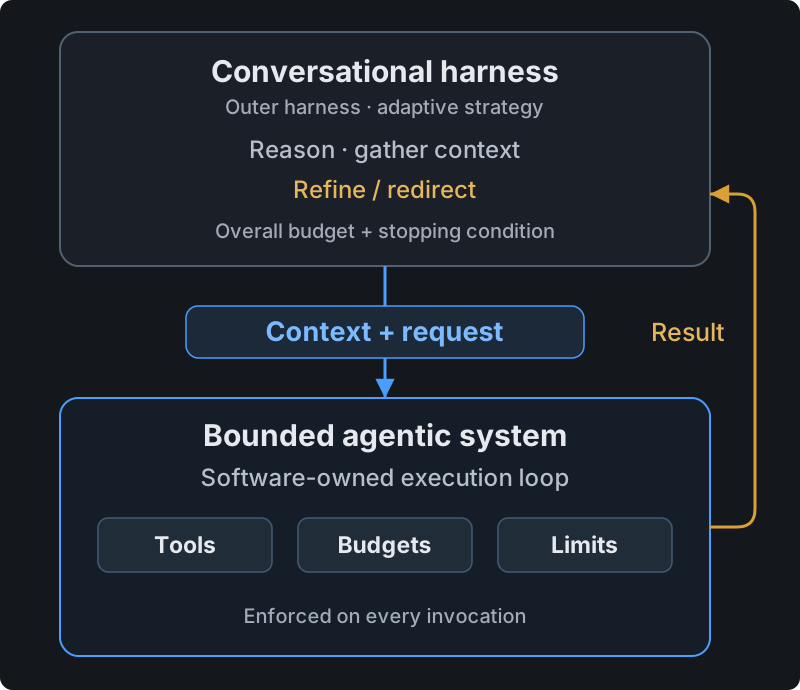
The outer harness owns adaptive strategy.
The inner harness owns bounded execution.
Context is the control surface between them.
That, to me, is the interesting part.
Context as a control surface
There’s an important caveat here: By “context,” I don’t mean “blindly append arbitrary untrusted text into a privileged system prompt and hope for the best.”
The inner system should still own its invariants. Its permissions. Its available tools. Its token and tool-call budgets. Its safety boundaries. Its deterministic orchestration where determinism actually matters. Context is guidance within those boundaries, not a mechanism for redefining them.
The runtime still enforces the tool allowlist and call budget. Asking nicely (or very insistently) in the context parameter doesn’t change either. That separation lets you preserve something I’ve found increasingly valuable. You don’t have to choose between a completely software-owned orchestration loop and throwing the entire problem at an unconstrained conversational agent. You can put an adaptive reasoning layer around bounded, software-owned agentic systems. If those systems expose a meaningful contextual interface, the outer harness can repeatedly steer them toward a useful result without taking ownership of their internal execution.
That gives you something that feels remarkably close to working directly with an LLM while preserving the durability, observability and boundedness of a software-owned control loop. The inner harness doesn’t need to know how to solve every possible version of the problem. It needs to expose a bounded, durable capability that can be repeatedly steered by the outer harness.
That’s the part I hadn’t fully appreciated before.
Context isn’t just additional information for an agent. Between two harnesses, it becomes a control surface.
Comments