Runtime QA: Give the Agent the Loop, Not the Last Word
Runtime QA is judgment from end to end, so let the agent own the investigative loop. Separate its judgment from reviewable mechanics, stop for the decisions that carry consequences, and leave the last word with a person.
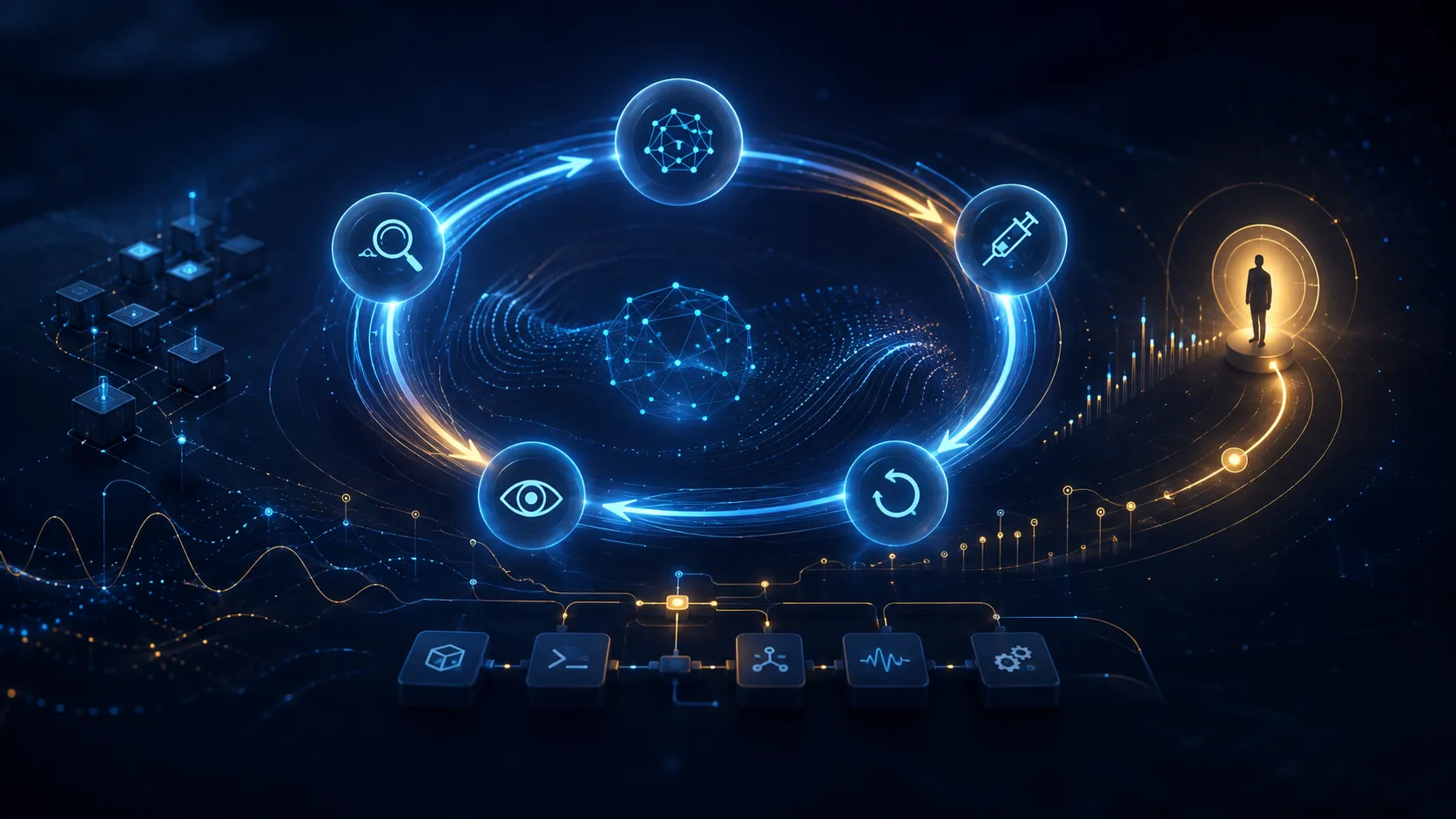
It’s four in the afternoon and I’m hand-stopping a container for the ninth time.
The stack came up half-broken, I’ve curled the same endpoint until my shell
history is nothing but curl, and I’m squinting at a wall of logs trying to
decide whether the thing I just saw was the bug, a local quirk, or a container
still running last week’s code. Tomorrow the author pushes seven more commits and I
get to do all of it again. This is runtime QA, and I have spent a genuinely
embarrassing number of afternoons exactly here.
Here’s the thing that finally bothered me enough to do something about it: almost none of that was work only I could do. Understand the change, assemble the environment, induce failures, watch the signals, restore, repeat. Much of it is necessary. Very little of it needs me, specifically, to turn the crank.
That gap is the whole opportunity. I’ve argued before that the real question is never simply “model or code in charge” but matching the harness to the problem, and being deliberate about where the model earns its cost. Runtime QA turns out to be a problem that genuinely wants the model in charge of a bounded investigative loop, which makes it a good place to be precise about what “in charge” should and shouldn’t mean.
First, which QA?
Teams use QA to mean different things. For some it’s static review: reading a pull request and judging whether the code is correct, maintainable, and adequately tested. For others it’s runtime verification: operating the running service in a representative environment, inducing real failures, and comparing what it does against what the change claims it should do. The trigger should be black-box wherever possible. Designing the test still requires reading the diff, and explaining a strange result may require reading the exact library code that ran inside the container.
Both matter, but they answer different questions and need different machinery. Static review asks whether the code looks right as written. Runtime QA asks whether the running system behaves as claimed. This post is about the second one. They belong side by side; neither subsumes the other, and I’ll come back to why.
The loop, and where the day actually goes
Written out, that afternoon has a shape:
- Read the change. Form a theory of what could break.
- Bring up a local stack. Discover it’s half-up.
- Hand-stop a dependency. Hand-hit an endpoint. Squint at container logs.
- Decide whether what you saw was the bug, a local-environment quirk, or a stale container running last week’s code.
- Write a summary in a chat channel that’s gone in a week.
- Repeat all of it from scratch when the author pushes seven more commits.
Steps 2 through 4 and 6 are where the afternoon goes, and none of them are the
part only an engineer can do. They’re also, not coincidentally, where the
mistakes live: an un-restarted container silently tests the old code, a 0 from a
broken log filter reads as “clean” (zero being indistinguishable from healthy, a
detail that will come back to bite us later), and nobody can reproduce last week’s
run.
So the question isn’t “can an agent do QA?” It’s sharper than that:
How do you move people out of the repetitive investigative loop without moving them out of the decisions that carry consequences?
The division of labour
The answer is not to take the model out of the driver’s seat. Read a diff, name what the change is observable through, decide which observation would reduce uncertainty, adapt when the environment contradicts the plan. That’s judgment-dominant work, so the model should own the investigative loop here. The trick is separating decisions that gather evidence from decisions that authorize consequences.
The model runs the investigation. It reads the diff, models what the change does, proposes what that change is observable through, shapes the test, drives the harness, and interprets each deviation as it happens. Letting it adapt mid-run is the feature, not a risk to engineer away. It can stop, gather more evidence, or ask before the next destructive phase. These outputs are valuable because they’re reviewable, not because they’re presumed correct.
A repeatable harness does the breaking and the watching. Not the loop, the building blocks the loop calls: a lever that stops a dependency and starts it again, an observer that reads one surface exactly, a poller that reports how many seconds a signal took to flip. The model authors that harness alongside the plan. Before a new or changed harness runs for the first time, the skill summarizes what it will do and stops for confirmation. During execution, the model drives named subcommands rather than reimplementing the mechanics inline. When a harness bug appears, that is a finding to fix and record, not something to wave away because the shell happens to be deterministic.
The human keeps the consequential decisions. In practice, the high-value ones are a short list:
- Does the model of the change make sense? The test states, in prose, what the change does and which signal gates which behaviour. A wrong model produces confident, false findings. Reading the plan before the first run is the highest-value human review in the process.
- Should this harness run at all? Before the first execution of a new or changed harness, the runner summarizes the shell and asks. Individual plans add more gates around heavier steps such as checking out another commit, rebuilding images, or changing infrastructure config. Ordinary inject/restore cycles can then run inside that approved scope.
- Is this finding real, or is it the environment? The result preserves the agent’s disposition and mechanism. A human with production context gets the last word.
- What ships? Approving the change, posting results, moving a tracker item. All outward-facing, all human. The automation stops at the result file by design; nothing downstream of it fires on its own.
Everything else is either AI-assisted investigation or a turn of a repeatable crank, and neither should consume a senior engineer’s afternoon.
The artifact is the point
Concretely, the shape I’ve landed on is two skills and three artifacts. One skill turns a change into a durable test plan and a plan-specific harness. Another reads the plan and drives that harness against the environment. At the end it writes a timestamped result. The specifics of how you package those matter far less than one design decision underneath them:
Separate the judgment from the mechanics, physically.
- One file holds judgment: what the change does, what signal proves it, what’s out of scope and why, where to stop and ask a human. Prose a reviewer can argue with, and prose the model reads at run time to decide what to do next.
- A separate script holds deterministic mechanics: the pollers, the levers that break things, and the classification of what came back. Code, not prose, because “wait until this field flips, and report how many seconds it took” has to mean the same thing each time it runs.
- A timestamped Markdown result holds evidence: the target revision, expected versus observed behaviour, measured latencies, findings, skipped tests, and whether the stack was green at the end. It is a durable report, not a machine certification.
This buys you the thing a chat transcript never will. Re-runs are cheap to start and much easier to compare: the same entrypoint, four days and seven commits later, produces a new result beside the last one and records any plan or harness changes needed along the way. It isn’t perfect reproducibility; the plan, shell, images, and local state can all move. It is a durable narrative of what was run, what changed, and what the agent concluded. Findings arrive with a mechanism attached, not a vibe: a named line in a named version of a dependency, with the call chain that reaches it, rather than “the logs looked noisy.”
The environment sets the ceiling
An AI-driven QA cycle is bounded by what the agent can actually break and actually see. Everything upstream of that boundary is wasted effort. So the unglamorous investment, the local environment you test against, is what determines whether any of this is worth doing.
The instinct when building a local stack is to stub whatever is annoying. For QA,
that instinct is often backwards: the annoying dependencies are usually where
the interesting bugs are.
If production runs a real broker with real mutual TLS, terminate real TLS locally.
If production traffic traverses an egress proxy, route through it locally instead
of exempting yourself because it’s simpler. Client TLS config, handshake failure
paths, the proxy’s CONNECT path: none of that executes in a stack that mocks it
away, and all of it is a genuine source of production incidents.
One of the highest-value choices is this: preserve the process boundaries that matter. Separate processes expose independent lifecycle, identity, and state ownership assumptions a single-process rig hides. Give the API and its background scheduler separate identities and log streams when production does. You will not reproduce every production topology locally, but collapsing everything guarantees you will never see the differences.
The gaps are first-class data
Your local stack will never be production. It’ll have missing mocks, credentials that only work against staging, and behaviour keyed on per-instance identity a container can’t reproduce. These gaps are the main source of false findings, so name them explicitly, in writing, before any test runs.
Every plan I write carries a preconditions section whose only job is to pre-empt a wrong conclusion. If some health sub-check always fails locally because there’s no mock for one dependency, the plan says so, and asserts on something else. A failing check at baseline is then expected, not a finding. Writing that down first is what converts “the endpoint is broken!” from a false alarm into a known precondition.
The same section can rule out a wrong way to break something, which is subtler and more valuable. Stopping a proxy container entirely might look like the obvious way to test a proxy-failure path, but if it makes the client’s TCP connect fail before the changed code even runs, it’s testing a different path the change never touched. That’s hard-won environmental expertise, captured in a file, and applied automatically on every future run. Accumulating those is most of the long-term payoff.
What it catches that the other stages don’t
Two shapes of problem convinced me this earns its keep.
The first is the cross-process interaction. A refactor can look correct in review and pass its unit tests while a background writer in one process masks a local override in another. In my rig, that turned out to be an environment detail and a production assumption worth confirming, not automatically a product defect. The harness made the interaction visible and forced the distinction.
The second is depth outside your team’s expertise. Picture a fix for a production log storm caused by a failure escaping a third-party client’s intended error boundary into a retry loop. Validating it means holding proxy behaviour, the client’s reconnect state machine, and structured logging semantics at once, none of which is your own product code. An agent can cheaply traverse those sources, propose where the failure escaped, then test that explanation against the real dependency and the library version inside the container. Unit tests often won’t reproduce that seam unless it has been deliberately modelled.
A minimal harness
All of that stays abstract until you see the pieces sitting next to each other, so here’s the smallest version that still makes the point. Taken together, what follows is not a one-off script; it’s a small, purpose-built harness you own. Start with a toy order service backed by a compose file that splits the processes production would split.
Note the packaging up front, because it’s the whole point: in my setup, one Claude slash command authors the artifacts and another runs them. They’re prose the model reads and interprets, which is what lets it react to whatever the run actually produces rather than following a fixed script off a cliff.
# docker-compose.yml: the environment
services:
  api:
    build: ./order-service
    environment:
      STATE_URL: redis://state:6379
    ports: ['8080:8080']
    depends_on: [state]

  # A separate process, exactly as production runs it. The process boundary is
  # part of the behaviour this test is meant to exercise.
  refresher:
    build: ./order-service
    command: python -m order_service.refresher
    environment:
      DATABASE_URL: postgres://orders:orders@database/orders
      STATE_URL: redis://state:6379
    depends_on: [database, state]

  database:
    image: postgres:17
    environment:
      POSTGRES_DB: orders
      POSTGRES_USER: orders
      POSTGRES_PASSWORD: orders

  state:
    image: redis:7
The refresher is the whole reason this environment is worth anything. It writes
database health into shared state the api reads. That makes the process boundary
part of the test: stop the database and the scheduler has to observe the failure,
publish it, and let a different process gate readiness on it. It also means a
per-instance override on the api can be overwritten by the separately running
writer. Collapse the two and both interactions disappear from the local rig.
The authoring instructions point the model at a pull request, walk it through the diff, and have it write a plan and harness into a directory for that change. The running instructions locate that plan later, read it, and drive it against the stack. Authoring produces the first two artifacts, and both are worth a human read before the first run:
> /runtime-qa:create https://example.test/order-service/pull/42
Read the diff. Wrote plan.md + health-test.sh. Review before running.
The plan is prose a human argues with. The harness holds the deterministic mechanics. Keeping them in separate files is the load-bearing decision from earlier, made physical. Here’s a compact version of what the model produced:
<!-- plan.md: the judgment -->
## Change under test
Readiness must go unhealthy within one refresh interval (~5s) of the database
becoming unreachable, and recover within one interval of it returning.

## Preconditions
- The stack must be green before injection; otherwise detection timing is meaningless.
- Stopping `api` is the WRONG lever: it fails before the readiness path runs.

## Gate matrix
| Lever | Readiness | Liveness | Timing |
|---|---:|---:|---|
| database stopped | 503 | 200 | within ~5s |
| database restored | 200 | 200 | within ~5s |
#!/usr/bin/env bash
# health-test.sh: plan-specific mechanics. Judgment stays in plan.md.
set -uo pipefail
code() {
local got
if ! got="$(curl -sS -o /dev/null -w '%{http_code}' \
--connect-timeout 2 --max-time 5 http://localhost:8080/"$1")"; then
echo "transport error reading $1" >&2
return 2
fi
echo "$got"
}
await_code() {
local path=$1 want=$2 timeout=$3 start=$SECONDS got
while true; do
got="$(code "$path")" || return 2
[[ "$got" == "$want" ]] && break
(( SECONDS - start < timeout )) || return 1
sleep 1
done
echo "$path reached $want after $((SECONDS - start))s"
}
preflight() {
local service got
for service in api refresher database state; do
docker compose ps --status running --services | grep -qx "$service" || return 1
done
got="$(code readyz)" || return 2
[[ "$got" == 200 ]] || return 1
got="$(code livez)" || return 2
[[ "$got" == 200 ]]
}
case "${1:-}" in
preflight) preflight ;;
inject) docker compose stop database ;;
restore) docker compose start database ;;
restore-all) docker compose start database ;;
await) await_code "$2" "$3" "$4" ;;
*) echo "unknown command" >&2; exit 2 ;;
esacThat script is not magically trustworthy because it is shell. It is generated, approved after a summary, and sometimes wrong. In practice I’ve found wrong process names, wrong log assumptions, and observers pointed at a surface that could never contain the thing they were looking for. The useful property is that each mistake lands in a small artifact you can inspect, fix, rerun, and keep, rather than disappearing inside the model’s next turn.
Naming the surface (/readyz, not the body), spotting the wrong lever (stopping
api), and encoding the timing (~5s, not a bare sleep) is the judgment the
model applied while authoring. Before first execution, the runner summarizes the
plan and the shell it will run. It then drives named harness commands, but the
loop is the model’s: it reads each result, interprets it against the matrix, and
decides whether to continue, gather more evidence, or stop.
> /runtime-qa:run change-42
preflight → API, refresher, database, and state store running; /readyz=200; /livez=200
new harness: stops database, polls readiness/liveness, then restores database
> approve
inject    → health-test.sh inject     → database stopped
await     → health-test.sh await readyz 503 10 → reached 503 after 4s
observe   → health-test.sh await livez 200 2   → reached 200 after 0s
restore   → health-test.sh restore    → database started
await     → health-test.sh await readyz 200 10 → reached 200 after 3s
teardown  → health-test.sh restore-all; health-test.sh preflight → baseline green
result    → result-2026-08-13-164209.md
PASS: readiness gated on database; liveness did not; stack green at teardown.
That reads like a fixed sequence, and on a clean run it is. The value shows up when it isn’t. I’ve watched the agent stop because the baseline was already sick, discover that a long-running process still held yesterday’s module even though the file on disk was current, and replace an invalid observation with one that actually reached the runtime surface. A fixed pipeline would need those branches written in advance. Here the agent can investigate them as they appear, and the result records what changed.
That does not turn procedure into a guarantee. The run skill says to restore all
levers and re-run preflight even after a failure, and the result records whether
the stack ended green. That discipline has worked well in normal runs. It will
not save you if the agent process dies between inject and restore; some plans
also leave the tested branch checked out or an image built from it. Those are
exactly the reasons new harnesses get an approval gate, heavier phases add explicit gates,
and teardown state belongs in the artifact rather than being assumed.
The result is timestamped Markdown, not a signed certificate. It records the target revision when knowable, expected versus observed behaviour, latencies, findings, skipped tests, investigation notes, and the final state of the stack. It can also record harness corrections made during the run. That is enough to make the work durable and the next run meaningfully comparable without pretending the report is immutable or the verdict came from anything other than judgment.
Taken together, that’s a small, purpose-built AI harness: a faithful environment, an agent-owned investigation, inspectable mechanics, and a result that survives the conversation. The model owns the loop. A person still approves the parts that can leave a mark and gets the last word on what the findings mean.
Failure modes to design against
Every one of these is a way an AI-driven QA cycle produces a confident, wrong answer. They’re worth internalizing because they’re not hypothetical; they’re what actually goes wrong.
- False green from a broken observer. The worst failure, and the
0-is-clean detail I promised would come back. A log classifier silently bucketed every line to zero because it choked on a line prefix, and printedWARN=0 ... baseline GREENwhile real warnings sat right there in the window. It didn’t look like a bug; it looked like health. Never let an observation primitive fail open to a healthy value. Zero is indistinguishable from healthy, which is precisely why it lies so convincingly. Design counters so a classifier failure is visible, a total that disagrees with the sum of its parts, rather than silent. - The wrong lever. Breaking something adjacent to the thing that changed. Guard by requiring the plan to state why a given lever reaches the changed code, and to name the plausible-but-wrong lever explicitly.
- The stale container. The most common way a local pass lies: the file on disk is new, the running process imported the old module, or one service runs a fresh bind mount while a worker still runs code baked into an old image. Compare the branch, the source inside the container, and a live runtime marker before trusting a single line of output.
- The confident-but-wrong model. Guard with a rule that every claim about the change cites a specific line, plus the human read of the plan, plus a runtime willingness to conclude “the plan was wrong, the code is fine.”
- The over-tight assertion. An assertion worded more strictly than the property you actually care about will raise false alarms. State the intent alongside the literal check so the agent can report both what happened and whether the property survived. If those disagree, call out the plan defect; don’t quietly erase the literal result.
- The collapsed error. An HTTP 503 is evidence. A connection failure, timeout,
malformed response, and broken observer are not four spellings of 503. Make
transport failure visible and bound every request. The harness template that
started this work returned
000for failed requests; that was useful for polling, but much too easy to mistake for an application result. - The unreviewed harness. The shell is executable code with Docker access, often authored specifically for the change. Review the exact harness revision before the first run, keep mutation in named subcommands, reject paths that escape the plan directory, and stop if the plan asks for arbitrary inline shell. This is risk reduction, not a sandbox.
There’s also a security dimension, and it’s sharper precisely because the model
owns the loop. A plan and shell harness authored in a repository are a
prompt-injection and code-execution surface pointed straight at an agent with a
host shell. Confining the harness to the plan’s scripts/ directory, invoking
only its named subcommands, refusing secret access, and asking before the first
execution of new shell are worthwhile guardrails. They are not a hard capability
boundary: once selected, that shell still has the agent’s host and Docker access.
The honest description is that this workflow assumes a trusted local checkout and
a person willing to trust the exact harness revision after reading what it will
do. I would not point the same arrangement at arbitrary third-party pull requests
and call it safe.
What this does not replace
I want to be precise about scope, because the failure mode of any post like this is someone reading it as “AI can do all your testing now.”
- Unit tests. Faster, white-box, and the right home for branches the stack can’t induce. This complements them; it doesn’t compete.
- Static code review. Runtime verification models behaviour; it never reads the change comprehensively for maintainability, design quality, and static defects. Run both; they fail in different directions.
- Cluster and production validation. Per-instance and true multi-node behaviour needs real orchestration, and no amount of local rigour reproduces production scale. Say so, and record the gap as unverified where you can’t measure honestly.
- Human judgment on release. Every outward-facing step stays gated on a person, deliberately, not for lack of tooling.
Where this lands
Reading a diff, naming what a change is observable through, deciding which piece of evidence to gather next, and recognizing when the environment has invalidated the plan: that’s judgment-heavy work, and it’s why the model belongs in the loop here rather than being called from the side of one. Polling a signal, measuring latency, and invoking a named mutation are harness responsibilities. Interpreting what came back is deliberately still model work. Deciding whether to accept that interpretation and whether the change ships stays human.
That’s what “give the agent the loop” means in practice. Let it form the theory, drive the approved harness, and follow the evidence when the run gets weird. Stop for the steps that can leave the environment changed. Keep the result as an artifact a person can inspect, and keep the last word on the finding and the release with that person.
None of which is to say this is the shape, or that it’ll map cleanly onto your stack. It’s the one that fit my problem, on my afternoons, after enough of them went the way the one at the top of this post did. Yours may draw the lines somewhere else, and I’d genuinely like to hear where. But if you’re spending your own afternoons hand-stopping containers and squinting at logs, I’d at least think hard about which parts of that actually need you in the chair. In my experience, it’s fewer than it feels like.
Comments