TRANSMISSION//OPEN ENTRY_023
Dude, how does this help me?
Putting the pieces together: how I’m using agentic systems in my daily workflow and the patterns that have stuck along the way.
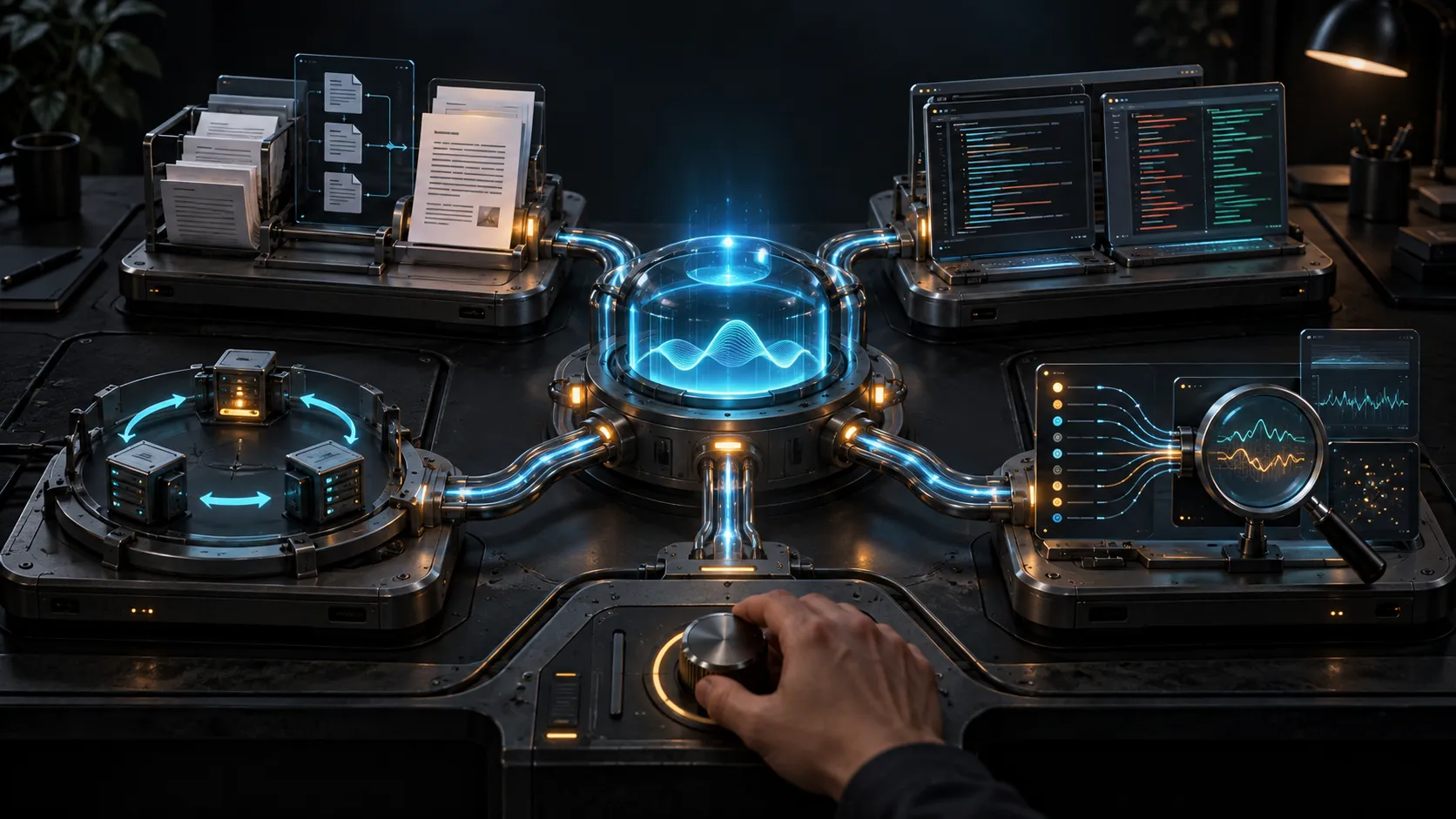
I’ve been tinkering a lot with models and harnesses over the last while, particularly from a local DX perspective. DX tooling has always been of great interest to me. How can I improve my own life by automating the boring things? Bringing AI into the equation has made the work that much more interesting. I’ve thrown a fair amount of shit at the wall to see what sticks. Some things have been successful, many others have failed. Like all failures though, learnings were had. I’ve written about a number of them and shared. However, each piece, each learning has more or less existed in isolation. While each piece speaks to the learnings, designs and architecture, there isn’t a piece putting it all together.
How do I actually use this stuff on a daily basis, or is it vaporware?
No, it most definitely is not.
The mindset shift
When I start tackling a problem, I don’t jump right to prose and hand it off to an agent to run. I look at the nature of the problem I’m trying to solve. Prior to the explosion of LLMs, is this something that I’d want to automate for myself or something that requires me to drive? If it’s something I would have previously automated, that signals to me that it’s something that can be implemented in code. It does not actually need an LLM to run every time. On the other hand, if I was previously driving then that should be a task for the LLM. I’ve written about this in more detail here.
It’s important to note that these are not mutually exclusive. A workflow can have deterministic topology that has non-deterministic subtasks. Similarly, a workflow can also be entirely judgement-driven but have deterministic subtasks.
The patterns
Following this mindset shift has led me to find a few emerging patterns that I’ve seen recurring over a number of different problem spaces.
| Pattern | Description |
|---|---|
| Harness within a harness | Using MCP as a seam between a conversational agent and a software-defined agentic system |
| Context as a control surface | Passing arbitrary context into the inner harness so the outer agent can steer successive executions |
| Runtime system harness | Giving agents a production-like environment, tools and operational knowledge for end-to-end runtime analysis and QA |
| Deterministic graph, agentic nodes | Defining workflow topology in software while delegating bounded judgement-heavy stages to agents |
The seam and the tools
These patterns are great and all, but the “harness within a harness” is key for my current work. This is what allows me to have a conversational harness (one and the same as your daily coding harness - Claude Code, codex et al.) that drives an underlying agentic system. The seam is MCP.
The coding harness is my peer. It’s who I bounce ideas off of. It’s who pulls together context for me from various sources: Slack, user stories, email, etc. The coding harness is who will typically write my code, conduct research and execute runtime QA for me against work done.
My repeatable tasks, be they agentic, deterministic or a blend, live as MCP tools. Using MCP allows me to quickly and easily swap between top level harnesses while the underlying functionality stays consistent. The agentic systems built underneath (I used FastMCP and LangGraph for mine) allow me to build out graph-based workflows, constrain costs by using specific models for specific tasks and engineer context for multi-agent workflows.
Tools exposed to the conversational harness are either ephemeral or long lived.
Ephemeral tasks are exposed as a single MCP tool. Long lived tools use an async
protocol with the following lifecycle stages (create, get, cancel,
commit (optional)). This interface allows the conversational harness to manage
the lifecycle of a task given an opaque task ID as a response to create.
Ephemeral
One continuous request
- Prompt
- Tool call
- Result
Durable
Revisited across requests
- Prompt
- Create
- Task ID
- Get while running
- Preview if needed
- Commit
The benefits and a deeper dive of the ephemeral vs. long-lived tool interface can be found in The Harness within the harness.
Daily life
Enough talk! What does my daily workflow actually look like with all of this stuff employed?
Creating user stories
I have an MCP user_story_create tool that will create a user story
against our internal system. This is an ephemeral tool and has a deterministic
topology. However, thinking about the human workflow made me realize I also
needed a helper: user_story_draft. Drafting takes a number of parameters (i.e.
assignee, title, description, etc), validates the parameters, does lookups as
needed and then composes a draft based on an internal template and renders it to
the conversational harness. Drafts are persisted temporarily.
user_story_create then commits the draft to the system and provides the
relevant link and other data to the conversational harness. In practice, it
might look something like this:
Create a user story using the context from this Slack thread: [URL]. Assign it
to me and give it 3 story points.
The story is created deterministically using a template. Every story created has the same structure, increasing readability. The same models are used for the same subtasks every time.
PR reviews
This is a more complex tool. It is long lived and durable, so it observes the async protocol described above. This doesn’t just hand off a PR review to a model. It clones the repo, creates a git worktree, computes the diff locally and then reviews. The review loop is comprised of multi-model-family reviews across multiple dispositions. Multiple loops to review, deliberation with other models and finally aggregation, preview and posting to GitHub.
This is graph and context engineering rolled into a set of related tools. What it looks like in practice is:
Review this PR: [URL]I use this for an initial review of my own work. Because of the async interface design, the conversational harness will preview the findings and if it’s something I’m actively working on, will typically suggest making the changes before posting the review. I also use it as a backup for review peer work. I feel fairly comfortable leaving the syntax and functional review to the automated process. I can spend my time and effort on the part that really takes my judgement: the intent of the change.
Runtime QA
Runtime QA is a little different. Instead of reaching an inner harness through MCP, the conversational harness is given a production-like local environment that it can operate directly. The environment runs the real services and keeps the process and dependency boundaries that matter in production. This gives the agent something it can actually break, observe and restore rather than asking it to reason about runtime behaviour from code alone.
When a change is ready, my prompt is usually about as exciting as:
Runtime QA this PR: [URL]The agent reads the change and creates two artifacts: a test plan containing its model of the change and a small, plan-specific harness containing the repeatable mechanics. Before running a new or changed harness it summarizes what will happen and waits for approval. From there it drives the loop: establish a healthy baseline, introduce the relevant failure, observe the system, restore it and follow the evidence when the result doesn’t match the plan.
Each run produces a timestamped result containing the revision tested, expected and observed behaviour, findings, anything that was skipped and whether the environment was healthy when the run finished. When another set of commits arrives, I can run the same plan again and compare the results instead of reconstructing the afternoon from shell history. I go into this in much more detail in Runtime QA: Give the Agent the Loop, Not the Last Word.
Incident investigation
Incident investigation usually starts with a page or a noisy thread containing half the story. The conversational harness first pulls that material together with the affected environment, a bounded time window and whatever alert, request or deployment identifiers are available. An intake tool checks whether that dossier is actionable. If it isn’t, the conversational harness can gather the missing context or ask me for it before starting an expensive investigation.
In practice, the handoff is still simple:
Investigate the incident described in this thread: [URL]. Ignore all but the EU
region as that's the only impacted one right now.
The investigation itself is long lived and durable. An investigator works from the dossier using read-only access to metrics, logs and the exact version of the deployed source. It tries to establish what happened, the impact and the best-supported root cause. A separate model then tries to falsify that result. If it finds unsupported claims, contradictions or missing checks, its feedback is routed back through another bounded investigation pass. Sometimes the honest answer at the end is still inconclusive, which is considerably more useful than a confident story built on a gap in the evidence.
Inconclusive doesn’t have to mean done. The conversational harness can use the result as context for the next attempt, narrowing the time window, focusing on a specific signal or adding evidence that wasn’t available in the first pass. In this way, context becomes the control surface: I can steer successive investigations through conversation while the underlying workflow stays bounded and repeatable.
The result includes the evidence, hypotheses ruled out, limitations and follow-up work. If I’ve supplied an incident thread, the workflow also prepares the exact reply it wants to post and stops at a preview. The conversational harness shows me that reply, but nothing is published until I explicitly commit it. The agent gets the investigative loop; I keep the last word on the conclusion that leaves the system.
What about coding?
You may notice that coding tasks were omitted from the examples above. That’s intentional. Coding is still a highly dynamic and judgement-heavy activity. There may be deterministic parts of the workflow around it (creating a user story, running tests, validating runtime behaviour, reviewing a diff) but I haven’t found much value in trying to encode the entire coding process itself as a fixed end-to-end workflow. The shape of the work changes too much depending on the problem. Sometimes the agent needs to explore. Sometimes it needs to ask questions. Sometimes it needs to read half the repository before touching anything. Sometimes the right answer is to make a tiny change and move on.
So rather than baking the whole process into a graph, I prefer to expose the repeatable pieces as composable tools and let the conversational harness decide how and when to use them. The deterministic parts stay deterministic. The judgement-heavy control loop stays with the model.
Why not skills?
You may also notice that there is only one section above that really talks about skills: Runtime QA. This is mostly a consequence of where I’ve chosen to put the system boundary. Skills are great for giving a harness instructions, conventions and reusable behaviour. But for the kinds of workflows I’m describing here, I usually want more than instructions. I want code, dependencies, tests, model selection, context engineering, durable state, lifecycle management and CI to all live together behind a stable interface.
MCP gives me that boundary.
Instead of teaching every conversational harness how my PR reviewer, incident investigator or user-story workflow works, I expose the capability through MCP and keep the implementation behind it. The outer harness only needs to understand the interface. The underlying system can evolve independently.
There’s also a portability benefit. I don’t want to re-architect the same workflow around the conventions of whichever coding harness I happen to be using this month. Keeping the implementation behind MCP means I can move between Claude Code, codex or whatever comes next without moving the actual system with it. That doesn’t make skills bad or MCP inherently better. They solve different problems. If what I need is mostly reusable guidance for an agent, a skill can be the right abstraction. If what I need is a repeatable software-defined system with its own runtime and guarantees, I prefer putting that system behind MCP.
It’s still early!
This isn’t the architecture, I’m not promoting it as such. This is the shit that has stuck on the wall with the various experiments I’ve tried thus far, the mindset I’ve adopted when working on agentic systems and the patterns that have emerged while doing so.
The ground is shifting so rapidly in AI that it’s hard to keep up. Feel free to reach out over available channels about approaches you’re taking or just to heckle. I’m super keen to hear what others are up to!
Comments